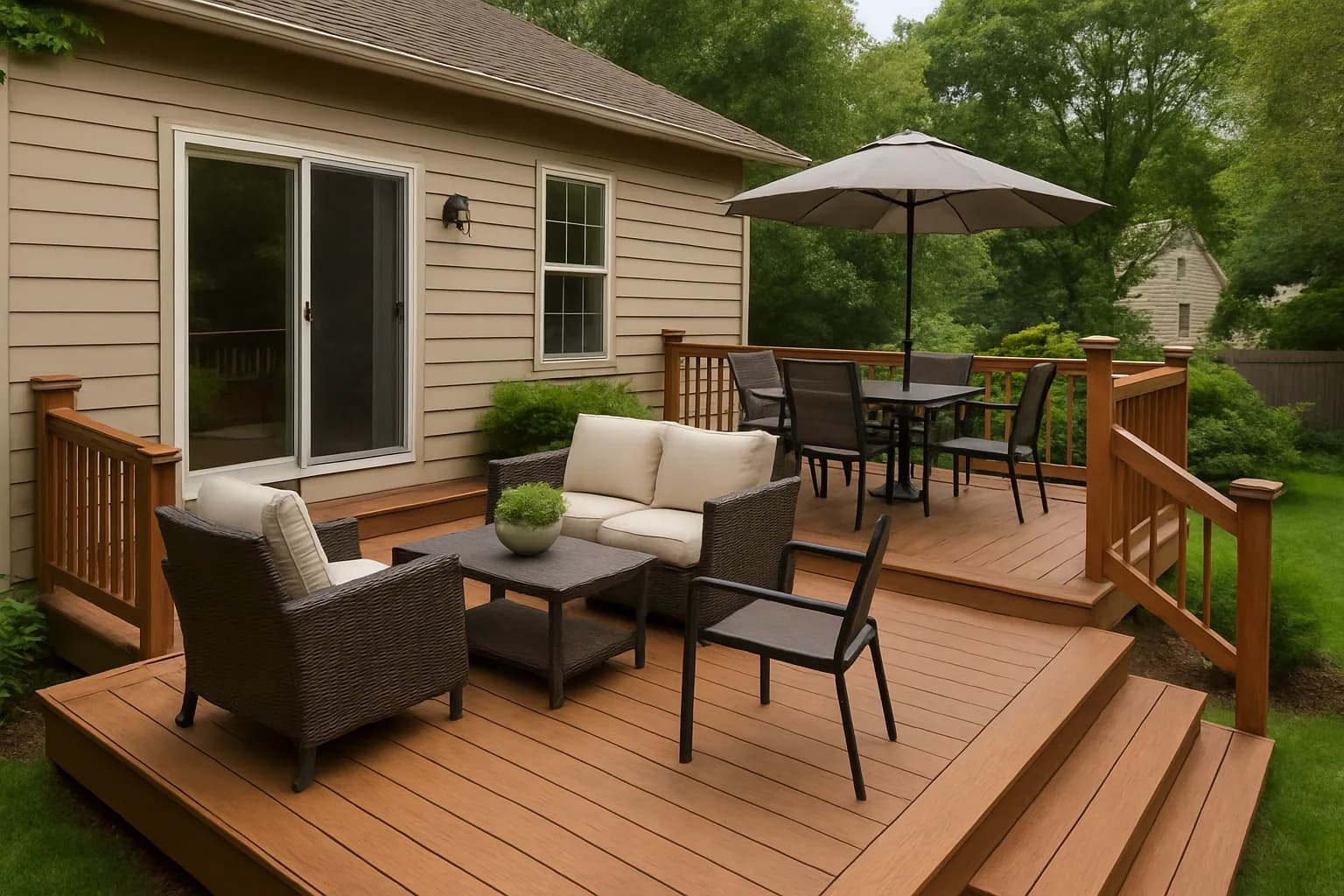
Deck budgets move quickly because decks combine structural work, finish materials, outdoor exposure, and local code requirements. A simple ground-level rectangle is one job. A raised composite deck with stairs, lighting, skirting, and permit complexity is a very different job.
For planning, a modest basic deck often starts around $4,000 to $8,000, a larger mid-range build often lands around $8,000 to $18,000, and a premium composite or specialty-material deck with stairs, rails, and upgrades can run well beyond that. Size matters, but material and elevation matter almost as much.
If you want a quote that does not drift later, define the structure first. What size? What height off grade? What railing condition? What stair count? What board material? Once those answers are clear, deck pricing becomes much less mysterious.
Planning table
Typical cost ranges at a glance
| Scope level | Typical range | What that usually includes |
|---|---|---|
| Basic pressure-treated deck | $4,000 to $8,000 | Smaller footprint, simple shape, low height, straightforward access. |
| Mid-range family deck | $8,000 to $18,000 | Larger footprint, rails, stairs, upgraded framing or finishes. |
| Premium composite or custom build | $18,000+ | Composite or hardwood, complex layout, multiple elevations, lighting, skirting, or heavy site work. |
What moves the number
The biggest cost drivers to pressure-test in quotes
| Cost driver | Impact | Why it matters |
|---|---|---|
| Material choice | High | Pressure-treated, cedar, composite, and specialty products change both upfront and lifetime cost. |
| Height, rails, and stairs | High | Guardrails, tall posts, stair runs, and site transitions add major labor and safety complexity. |
| Site access | Medium | Tight yards, slopes, and difficult footing conditions can move the budget even when the deck size stays the same. |
Turn this into your real project
Upload a photo and get a tighter range for your actual space.
These guides are here to orient you. Naili gets more useful when it can see your actual room, yard, roofline, or project area and turn that into a clearer brief before contractor quotes start.
Size matters, but not all square feet cost the same
Deck size gives you a rough starting point, but square footage alone can be misleading. A flat, accessible 12x16 deck at low height can price very differently from a 12x16 deck hanging off a slope with tall posts, stairs, and difficult excavation access.
That is why deck contractors often care as much about site conditions as raw dimensions. Post depth, footing complexity, drainage, grading, and how materials move through the site all influence labor. Two homeowners can describe the same size deck and still receive meaningfully different estimates because the site is doing half the talking.
Simple rectangles also cost less per square foot than decks with angles, curves, picture framing, multiple stair runs, or built-in seating. Shape complexity is not automatically bad, but it should be a conscious design choice, not a surprise that shows up on the final quote.
Material choice changes both upfront and lifetime cost
Pressure-treated lumber is often the most affordable starting point. Cedar and redwood sit higher. Composite and PVC products cost more upfront but appeal to homeowners who want lower ongoing maintenance and a more consistent finish look over time.
Material price is only part of the story. Some boards install faster than others, while some require more hidden fastener systems, precise gapping, or more expensive trim details. Premium materials can increase both materials and labor, which is why homeowners sometimes feel the jump twice.
If you are comparing wood versus composite, think beyond year-one cost. Staining, cleaning, eventual board replacement, and how much maintenance you will realistically do should be part of the decision, not an afterthought.
Rails, stairs, and elevation drive real cost
A deck that sits low to grade may avoid some of the complexity of taller builds, though local code still governs. Once you add guardrails, multiple stair sets, landings, or high-post conditions, the project can get meaningfully more expensive because those elements are labor-heavy and safety-critical.
Homeowners sometimes budget the deck surface and forget the rail package. That is a mistake. Rails can be a major cost bucket on their own, especially when you move from standard pressure-treated details into composite systems, metal balusters, cable, or glass.
Stairs work the same way. One clean stair run is manageable. Multiple stair sets, switchbacks, or steep site transitions can add real framing and finish complexity.
Permits, footings, demolition, and site work
Many deck projects require permits, inspections, and code-compliant footings. Permit fees are rarely the dominant line item, but they are part of the budget and should not be missing from the conversation. If an old deck is being removed, demolition and disposal should be clearly separated or clearly included.
Site work can quietly move the number up too. Tight yards, poor access, grading issues, retaining needs, and utility conflicts all increase the labor burden. That does not mean the project should not happen, only that “deck cost per square foot” is not enough to price a real yard.
Get a custom estimate for your specific space, upload a photo and we will build the brief. A deck quote becomes much more useful when the footprint, access conditions, and desired finish level are all visible before the site meeting starts.
How to compare deck bids cleanly
Ask each contractor to spell out framing assumptions, board material, railing scope, stair count, permit handling, demo, disposal, and who is responsible for any site restoration around the work. If one bid includes skirting, fascia wrap, and permit pull while another does not, they are not comparable.
Also ask how the contractor handles hidden conditions. Rotten ledger areas, unexpected footing depth requirements, grading challenges, and concrete conflicts can appear only after layout begins. A serious contractor should explain how those issues are handled before you sign.
The goal is not the cheapest price. It is the clearest price for the exact deck you actually want. That is how you avoid paying for ambiguity later.
Frequently asked questions
Common follow-up questions
Is composite always worth the extra cost?
Not always. It makes the most sense for homeowners who care about lower maintenance and a more stable finished look over time.
Do deck permits really matter?
Yes. Structure, footings, guards, and stairs are safety issues, not cosmetic details. Permit rules vary, but they should be part of the conversation early.
What usually shocks homeowners on deck quotes?
Railing packages, stair complexity, site access, and demolition/disposal are the most common surprises.
Can I phase a deck project?
Sometimes, but structure and permit logic usually work best when the main deck is planned as one coordinated build rather than pieced together casually.